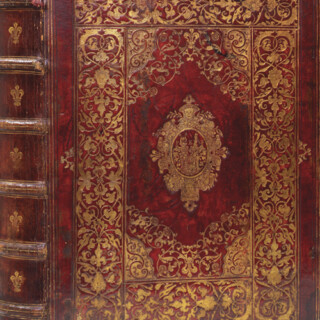
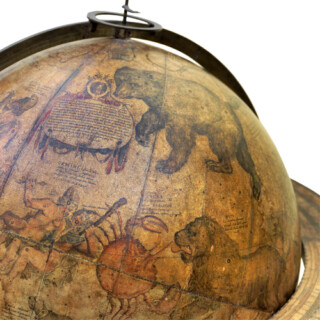
Folio (463 by 315mm). [60] ll., COMPLETE with the cancelled G3 bound at the end. Title-page framed by a woodcut border, on verso of the same leaf woodcut coat of arms of joint the dedicatees Charles V and his brother Ferdinand of Spain. 53 eleven-line and 39 six-line historiated woodcut initials by Hans Brosamer. 36 full-page woodcut astronomical figures coloured by a contemporary hand, of which 21 have a total of 83 volvelles [complete]. 39 [of 44] silk threads; and 8 [of 12] pearls. Full-page woodcut arms of the author by Michael Ostendorfer on fol. O6. The leaf G3 is repeated, printed in black with variants, at the end of the volume. A small letterpress cancel slip on recto of fol. K1 correcting the text. Contemporary Venetian polished fawn calf on pasteboards, covers decorated with frames in gilt and blind, outer gilt frame with floral tools at corners, inner gilt frame with quadrilobes and small aldine leaf tools at corner, remains of clasps. An extraordinary copy in its unusual original binding. A minor repair on fol. G3.
First edition of "the most luxurious and intrinsically beautiful scientific book that has ever been produced" (D.J. de Solla Price, Science since Babylon, p. 104), in an extraordinary hand coloured copy in first issue, as attested by the repeated fol. G3 and by the letterpress cancel slip on fol. K1r, preserved in a beautiful contemporary Venetian binding.
The author of this popular texbook in astronomy is Petrus Apianus, astronomer and professor of mathematics ...
First edition of "the most luxurious and intrinsically beautiful scientific book that has ever been produced" (D.J. de Solla Price, Science since Babylon, p. 104), in an extraordinary hand coloured copy in first issue, as attested by the repeated fol. G3 and by the letterpress cancel slip on fol. K1r, preserved in a beautiful contemporary Venetian binding.
The author of this popular texbook in astronomy is Petrus Apianus, astronomer and professor of mathematics at Ingolstadt, a veritable pioneer in the production of astronomical and geographical devices.
Apianus' work on the project began eight years before and the Astronomicum Caesareum, which was printed in his private press at Ingolstadt, is considered "the most spectacular contribution of the book-maker's art to sixteenth-century science" (Gingerich, Apianus's Astronomicum Caesareum, p. 168).
The handbook is divided in two parts: the first (ll. B1-M3) includes 40 chapters with maps reproducing the position and the movement of celestial bodies, while the second part describes the meteroscope, an instrument designed to solve problems in spherical trigonometry, and reletes the sighting of five comets: "The Astronomicon is notable for Apian's pioneer observations of comets (he describes the appearances and characteristics of five comets, including Hailey's) and his statement that comets point their tails away from the sun. Also important is his imaginative use of simple mechanical devices, particularly volvelles, to provide information on the position and movement of celestial bodies" (DSB., I, p. 179). For the dissemination of calculating technology in a standardized and reproducible form, Poulle has compared the appearance of 'paper instruments' to nothing less than the advent of printing (see Les instruments de la théorie des planètes, 1.83).
The present copy represents one of the most complete to have ever appeared on the market: the Horblit copy lacked 23 volvelles and one pearl, while the Honeyman copy lacked 7 volvelles, one silk thread and nine pearls.
bibliography:
bibliography:
Adams A, 1277; Schottenloher, Landshuter Buchdrucker, 42; Benezit II, 332; VIII, 49; Campbell Dodgson II, 242; DSB I, pp. 178-179; Lalande, p. 60; Gingerich, Rara Astronomica, 14; Stillwell, The Awakening Interest in Science during the First Century of Printing, 19; Van Ortroy, 112; Zinner 1734; D. J. de Solla Price, Science since Babylon, New Haven 1975, p. 104O. Gingerich, Apianus's Astronomicum Caesareum, «Journal for the History of Astronomy», 2 (1971), pp. 168-177; E. Poulle, Les instruments de la théorie des planètes selon Ptolémée, Genève 1980, 1.83; O. Gingerich, A Survey of Apian's Astronomicum Caesareum, in Peter Apian, ed. by Karl Röttel, Buxheim1995, p. 113.
 Trade card for maker of Philosophical Instruments
1 × £2,800
 Views along the Rhine
1 × £3,000
 Four rare lithographed maps depicting the operations of the British Army on the River Sutlej during the First Anglo-Sikh War of 1845-46
1 × £30,000
 Antwerp – home to van Dyck, Brueghel and Rubens
1 × £25,000
 Rocque’s Index to his monumental 24-sheet plan of London
1 × £1,500
 Moving Heaven and Earth
1 × £95,000
 “Nothing was more important for [ancient] Geography than to know the size of the Earth, and nothing seemed more difficult to undertake” (Cassini)
1 × £75,000
 Sixth planet from the sun
1 × £10,000
 “How beautiful are the one hundred sweet honey’s who are waiting for you”
1 × £600
 Speed’s map of ‘Low Germanie’
1 × £800
 Kandy land
1 × £200
 The first map devoted to America to appear in an atlas
1 × £50,000
 Standing on Cromwell’s Head
1 × £500
 “A Scottish astronomer of considerable reputation”
1 × £120,000
 The transit of Halley’s comet in 1758
1 × £12,000
 The cradle of the computer industry
1 × £20,000
 Foundation map of Silicon Valley – inscribed by the artist
1 × £28,000
 The young Charles II
1 × £400
 The most accurate representation of the West Indies and its environs
1 × £20,000
 The Arabian Sea
1 × £2,000
 “Such is the Infinity of these Isles…”
1 × £400
 Only known example of this map of Isole Palandure
1 × £3,200
 Welcome to Palo Alto
1 × £1,550
 Norie’s rare chart of the Pacific, and a tale of ‘Moby Dick’
1 × £45,000
 Views along the Rhine
 Four rare lithographed maps depicting the operations of the British Army on the River Sutlej during the First Anglo-Sikh War of 1845-46
 Antwerp – home to van Dyck, Brueghel and Rubens
 Rocque’s Index to his monumental 24-sheet plan of London
 Moving Heaven and Earth
 “Nothing was more important for [ancient] Geography than to know the size of the Earth, and nothing seemed more difficult to undertake” (Cassini)
 Sixth planet from the sun
 “How beautiful are the one hundred sweet honey’s who are waiting for you”
 Speed’s map of ‘Low Germanie’
 Kandy land
 The first map devoted to America to appear in an atlas
 Standing on Cromwell’s Head
 “A Scottish astronomer of considerable reputation”
 The transit of Halley’s comet in 1758
 The cradle of the computer industry
 Foundation map of Silicon Valley – inscribed by the artist
 The young Charles II
 The most accurate representation of the West Indies and its environs
 The Arabian Sea
 “Such is the Infinity of these Isles…”
 Only known example of this map of Isole Palandure
 Welcome to Palo Alto
 Norie’s rare chart of the Pacific, and a tale of ‘Moby Dick’