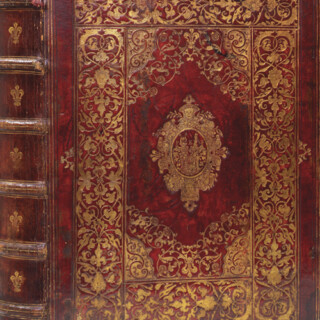
Folio (468 by 310mm). [59] ll. [plus one cancel, see below], COMPLETE. Title-page framed by a woodcut border, on verso of the same leaf woodcut coat of arms of joint the dedicatees Charles V and his brother Ferdinand of Spain. 53 eleven-line and 39 six-line historiated woodcut initials by Hans Brosamer. 36 full-page woodcut astronomical figures coloured by a contemporary hand, of which 21 have a total of 83 volvelles [complete]. 24 have 43 (of 44) silk threads; and 11 (of 12) seed pearls, an additional black and white plate bound at rear. Full-page woodcut arms of the author by Michael Ostendorfer on fol. O6, a fine, unpressed copy in contemporary blind-stamped pigskin-backed wooden boards, spine covered in eighteenth century in sheep, preserved in a full morocco box.
First edition of "the most luxurious and intrinsically beautiful scientific book that has ever been produced" (de Solla Price), in an extraordinary hand-coloured early issue, as attested by the letterpress cancel slip on fol. K1r, preserved in a beautiful contemporary German binding, with turned wood depressions to accommodate the volvelles on the inside of each board.
The author of this popular textbook in astronomy is Petrus Apianus, astronomer and professor of...
First edition of "the most luxurious and intrinsically beautiful scientific book that has ever been produced" (de Solla Price), in an extraordinary hand-coloured early issue, as attested by the letterpress cancel slip on fol. K1r, preserved in a beautiful contemporary German binding, with turned wood depressions to accommodate the volvelles on the inside of each board.
The author of this popular textbook in astronomy is Petrus Apianus, astronomer and professor of mathematics at Ingolstadt, and a veritable pioneer in the production of astronomical and geographical devices.
Apianus's work on the project began eight years before and the 'Astronomicum Caesareum', which was printed in his private press at Ingolstadt, is considered "the most spectacular contribution of the book-maker's art to sixteenth-century science" (Gingerich, "Apianus's Astronomicum Caesareum").
The handbook is divided in two parts. The first (ll. B1-M3) includes 40 chapters with maps reproducing the position and the movement of celestial bodies. The second part describes the meteroscope, an instrument designed to solve problems in spherical trigonometry, and relates the sighting of five comets: "The Astronomicon is notable for Apian's pioneer observations of comets (he describes the appearances and characteristics of five comets, including Halley's) and his statement that comets point their tails away from the sun. Also important is his imaginative use of simple mechanical devices, particularly volvelles, to provide information on the position and movement of celestial bodies" (DSB).
The volvelles in the work are each placed within a frame reminiscent of an astrolabe, a contemporary device that modelled the movement of the heavens in two dimensions and enabled the calculation of time and place, and assisted with astrology. The first moveable woodcut, which represents the planispheric astrolabe, compresses both hemispheres onto one plate. According to the text, the plate depicts 1,033 stars, and was based on the first printed star charts published in 1515 by Albrecht Dürer.
The most spectacular of the volvelles, which are the work of the artist Michael Ostendorfer, are the dragon plates. These include the title-page and the double-page spread dragon and moon dials. The dragon dial can be used to calculate the nodes of the moon, the two points of intersection between the yearly path of the sun, and the plane of the lunar orbit, which produce eclipses. Dragons were associated with eclipses, which were believed to occur when their head or tail blocked the sun. The thirteen small dragons indicate different parts of the lunar cycle.
For the dissemination of calculating technology in a standardized and reproducible form, the appearance of "paper instruments" has been compared to nothing less than the advent of printing (Poulle).
Copies usually have far fewer volvelles than the present book, as for example the Honeyman copy, with 76. This example also has all but one of the sliding seed pearls (meant to be used as markers) which are almost always missing. The sheets are fresh, unpressed, and the volvelles tight and untorn; the double-page opening (verso of G3, recto G4) is in excellent state (the volvelles on G3 verso are usually torn away from opening as they are the only volvelles on a verso).
This copy has the following issue points: G4r has the text printed above the figure (i.e not on slips pasted on); K1r has correction slip pasted; the arms at the end are in the first (of three) states. In addition there is an unrecorded leaf signed 'G3', bound at the end. The full-page woodcut on the recto does not correspond to any in the book, while the text on the verso is a variant of that found on the recto of G3 and the verso of G4 in the book. This clearly was a trial setting that was cancelled. This copy has all of the threads apart from one on C3, and all of the pearls apart from one on G1; however it has an unrecorded pearl on B3. The turned wood depressions on the inner boards are apparently unique to the present example. Wood turning was a fashionable gentlemanly pursuit in early modern central Europe (as evidenced by the magnificent lathe from the collection of Maximilian I in the Bayerische Nationalmuseum), and the inset depressions in the covers are a splendid and practical to the problem presented by the thickness of the volvelles when binding copies of the Astronomicum.
"Some thirty-five copies of the Astronomicum Caesareum are known today. Fabulously expensive to produce and prohibitively expensive to buy, it was always a rare book. Nicholas Wotton reported in 1544 from the Diet of Speyer that Apian would give Henry VIII a copy, for otherwise the king would not be able to get hold of it; Edmund Halley tried in vain to obtain a copy" (Hebron).
bibliography:
bibliography:
Adams A, 1277; Schottenloher, Landshuter Buchdrucker, 42; Benezit II, 332; VIII, 49; Campbell Dodgson II, 242; DSB I, pp. 178-179; Lalande, p. 60; Gingerich, Rara Astronomica, 14; Stillwell, The Awakening Interest in Science during the First Century of Printing, 19; Van Ortroy, 112; Zinner 1734; D. J. de Solla Price, Science since Babylon, New Haven 1975, p. 104O. Gingerich, Apianus's Astronomicum Caesareum, «Journal for the History of Astronomy», 2 (1971), pp. 168-177; E. Poulle, Les instruments de la théorie des planètes selon Ptolémée, Genève 1980, 1.83; O. Gingerich, A Survey of Apian's Astronomicum Caesareum, in Peter Apian, ed. by Karl Röttel, Buxheim1995, p. 113.
provenance:
provenance:
Provenance: Wolfegger Kabinett (The Library of Castle Wolfegg near Ulm), from the estate of the Princes Waldburg.
Schloss Wolfegg is a Renaissance castle and seat of the princely family of Waldburg-Wolfegg, which still owns it today.
The Wolfegger Kabinett is a large private collection of mostly German graphics from the fifteenth and sixteenth century. Among its most famous pieces were the Waldseemüller map, the Mittelalterliches Hausbuch and the Kleiner Klebeband, all of which were sold in the early twenty-first century.
The Waldseemüller map - the first map to name America, was published In April 1507 in an edition of 1,000 copies by the German cartographers Martin Waldseemüller and Matthias Ringmann. The only surviving example was discovered in an album in the Wolfegger Kabinett in 1901 by the historian and cartographer Joseph Fischer. The album was originally the property of Johannes Schöner (1477-1546), astronomer, geographer, and cartographer in the Free Imperial City of Nuremberg. Later the family of Waldburg-Wolfegg acquired the map and it remained in their archives for more than 250 years. In 2001 the United States Library of Congress bought the map from Waldburg-Wolfegg family for ten million dollars. It is, therefore, not impossible, perhaps likely, that the present work was also acquired from Schöner by the family of Waldburg-Wolfegg.
 The transit of Halley’s comet in 1758
1 × £12,000
 One of the most important scientific maps ever published
1 × £30,000
 The most accurate representation of the West Indies and its environs
1 × £20,000
 Rare broadside illustrating the orbits of the known comets
1 × £8,000
 Catalogue V
1 × £15
 Indonesia – The Banda Sea, Indonesia
1 × £600
 Catalogue XX: Globalization
1 × £15
 Prague
1 × £1,200
 Cook’s Christmas
1 × £150
 The first atlas printed in Venice, the first wholly printed in colours, incorporating the first map to indicate Japan, the second map in a Ptolemaic atlas to show America.
1 × £150,000
 Catalogue XL: The Asala Collection
1 × £100
 Catalogue XXX: The William B. Ginsberg Collection
1 × £15
 Northern Africa
1 × £2,000
 Ptolemy’s first projection, with the “finest Ptolemaic plates produced until Gerard Mercator”
1 × £300,000
 A striking map of the Himilayas and Central Asia and China from the 1482 Ulm Ptolemy
1 × £9,000
 Leiden – home to Rembrandt, Lievens and, Dou
1 × £20,000
 Sanson’s Moluccas
1 × £300
 Jefferys’s edition of Saxton’s Atlas of England and Wales
1 × £30,000
 The Maldives, Sri Lanka and India
1 × £200
 The Gaspar Strait
1 × £250
 One of the most important scientific maps ever published
 The most accurate representation of the West Indies and its environs
 Rare broadside illustrating the orbits of the known comets
 Catalogue V
 Catalogue XII: The John W. Galiardo Collection of World Maps
 Indonesia – The Banda Sea, Indonesia
 Catalogue XX: Globalization
 Prague
 Cook’s Christmas
 The first atlas printed in Venice, the first wholly printed in colours, incorporating the first map to indicate Japan, the second map in a Ptolemaic atlas to show America.
 Catalogue XL: The Asala Collection
 Catalogue XXX: The William B. Ginsberg Collection
 Catalogue VIII: Views of London
 Northern Africa
 Ptolemy’s first projection, with the “finest Ptolemaic plates produced until Gerard Mercator”
 A striking map of the Himilayas and Central Asia and China from the 1482 Ulm Ptolemy
 Leiden – home to Rembrandt, Lievens and, Dou
 Sanson’s Moluccas
 Jefferys’s edition of Saxton’s Atlas of England and Wales
 The Maldives, Sri Lanka and India
 The Gaspar Strait