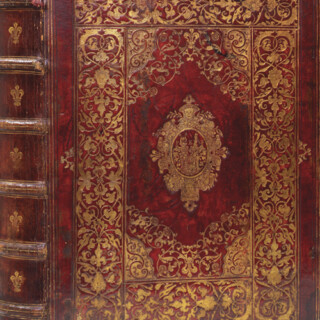
Folio (463 by 315mm), [60] ll., title-page framed by a woodcut border, on verso of the same leaf woodcut coat-of-arms of the joint dedicatees Charles V and his brother Ferdinand of Spain, 53 eleven-line and 39 six-line historiated woodcut initials by Hans Brosamer, 36 full-page woodcut astronomical figures coloured by a contemporary hand, of which 21 have a total of 83 volvelles [complete], 42 [of 44] silk threads, and 11 [of 12] pearls, full-page woodcut arms of the author by Michael Ostendorfer on fol. O6, a small letterpress cancel slip on recto of fol. K1 correcting the text, contemporary panelled blind-stamped pigskin over pasteboards, spine in six compartments separated by raised bands, remains of ties.
First edition of "the most luxurious and intrinsically beautiful scientific book that has ever been produced" (de Solla Price), in an extraordinary hand-coloured early issue, as attested by the letterpress cancel slip on fol. K1r, preserved in a beautiful contemporary German binding.
The author of this popular textbook in astronomy is Petrus Apianus, astronomer and professor of mathematics at Ingolstadt, and a veritable pioneer in the production of astronomical a...
First edition of "the most luxurious and intrinsically beautiful scientific book that has ever been produced" (de Solla Price), in an extraordinary hand-coloured early issue, as attested by the letterpress cancel slip on fol. K1r, preserved in a beautiful contemporary German binding.
The author of this popular textbook in astronomy is Petrus Apianus, astronomer and professor of mathematics at Ingolstadt, and a veritable pioneer in the production of astronomical and geographical devices.
Apianus's work on the project began eight years before and the 'Astronomicum Caesareum', which was printed in his private press at Ingolstadt, is considered "the most spectacular contribution of the book-maker's art to sixteenth-century science" (Gingerich, "Apianus's Astronomicum Caesareum").
The handbook is divided in two parts. The first (ll. B1-M3) includes 40 chapters with maps reproducing the position and the movement of celestial bodies. The second part describes the meteroscope, an instrument designed to solve problems in spherical trigonometry, and relates the sighting of five comets: "The Astronomicon is notable for Apian's pioneer observations of comets (he describes the appearances and characteristics of five comets, including Halley's) and his statement that comets point their tails away from the sun. Also important is his imaginative use of simple mechanical devices, particularly volvelles, to provide information on the position and movement of celestial bodies" (DSB).
The volvelles in the work are each placed within a frame reminiscent of an astrolabe, a contemporary device that modelled the movement of the heavens in two dimensions and enabled the calculation of time and place, and assisted with astrology. The first moveable woodcut, which represents the planispheric astrolabe, compresses both hemispheres onto one plate. According to the text, the plate depicts 1,033 stars, and was based on the first printed star charts published in 1515 by Albrecht Dürer.
The most spectacular of the volvelles, which are the work of the artist Michael Ostendorfer, are the dragon plates. These include the title-page and the double-page spread dragon and moon dials. The dragon dial can be used to calculate the nodes of the moon, the two points of intersection between the yearly path of the sun, and the plane of the lunar orbit, which produce eclipses. Dragons were associated with eclipses, which were believed to occur when their head or tail blocked the sun. The thirteen small dragons indicate different parts of the lunar cycle.
For the dissemination of calculating technology in a standardized and reproducible form, the appearance of "paper instruments" has been compared to nothing less than the advent of printing (Poulle).
"Some thirty-five copies of the Astronomicum Caesareum are known today. Fabulously expensive to produce and prohibitively expensive to buy, it was always a rare book. Nicholas Wotton reported in 1544 from the Diet of Speyer that Apian would give Henry VIII a copy, for otherwise the king would not be able to get hold of it; Edmund Halley tried in vain to obtain a copy" (Hebron).
The present example represents one of the, if not the, most complete copy to have ever appeared on the market: the Horblit copy lacked 23 volvelles and one pearl, while the Honeyman copy lacked seven volvelles, one silk thread, and nine pearls.
bibliography:
bibliography:
Benezit Dictionary of Artists (Paris: Editions Gründ, 2006) vol.II, 332 and vol.VIII, 49; Susan Dackermann, ed., Prints and the Pursuit of Knowledge in Early Modern Europe (New Haven: Yale University Press, 2011), 104-107; Campbell Dodgson, Catalogue of Early German and Flemish Woodcuts, vol.II, (London: British Museum, 1903), 242; George Kish, "Petrus Apianus", in Dictionary of Scientific Biography (vol.1), ed. Charles Coulston Gillesppie (New York: Scribner, 1970-80), 178-179; Stephen Hebron, Marks of Genius: Masterpieces from the Collection of the Bodleian Libraries (Oxford: Bodleian Libraries, 2014), 192-195; Owen Gingerich, Rara Astronomica (Cambridge: Harvard Library Bulletin, 1971), 14; Gingerich, "Apianus's Astronomicum Caesareum", Journal for the History of Astronomy 2 (1971), 168-177; Gingerich, "A Survey of Apian's Astronomicum Caesareum" in Peter Apian, ed. Karl Röttel (Buxheim and Eichstätt: Polyon-Verlag, 1995), 113; Fernand van Ortroy, Bibliographie de l'Oeuvre de Pierre Apian (Amsterdam: Meridian, 1963), 112; Emmanuel Poulle, Les instruments de la théorie des planètes selon Ptolémée, vol.1, (Geneva: Droz; Paris: Champion, 1980), 83; Derek J. de Solla Price, Science since Babylon, (New Haven: Yale University Press, 1975), 104; Margaret Bingham Stillwell, The Awakening Interest in Science during the First Century of Printing, 1450-1550 (New York: Bibliographical Society of America, 1970), 19; E. Zinner, Astronomische Instrumente des 11 bis 18 Jahrhunderts (Munich: Beck, 1956), 1734.
provenance:
provenance:
Provenance:
1. Bookplate of the Electorial Library of the Dukes of Bavaria. 2. Library stamp of Staatsbibliothek München with deaccession stamp. 3. Otto Schäfer Stiftung, Schweinfurt, Germany.
 Trade card for maker of Philosophical Instruments
1 × £2,800
 Views along the Rhine
1 × £3,000
 Four rare lithographed maps depicting the operations of the British Army on the River Sutlej during the First Anglo-Sikh War of 1845-46
1 × £30,000
 Antwerp – home to van Dyck, Brueghel and Rubens
1 × £25,000
 Rocque’s Index to his monumental 24-sheet plan of London
1 × £1,500
 Moving Heaven and Earth
1 × £95,000
 “Nothing was more important for [ancient] Geography than to know the size of the Earth, and nothing seemed more difficult to undertake” (Cassini)
1 × £75,000
 Sixth planet from the sun
1 × £10,000
 “How beautiful are the one hundred sweet honey’s who are waiting for you”
1 × £600
 Speed’s map of ‘Low Germanie’
1 × £800
 Kandy land
1 × £200
 The first map devoted to America to appear in an atlas
1 × £50,000
 Standing on Cromwell’s Head
1 × £500
 “A Scottish astronomer of considerable reputation”
1 × £120,000
 The transit of Halley’s comet in 1758
1 × £12,000
 The cradle of the computer industry
1 × £20,000
 Foundation map of Silicon Valley – inscribed by the artist
1 × £28,000
 The young Charles II
1 × £400
 The most accurate representation of the West Indies and its environs
1 × £20,000
 The Arabian Sea
1 × £2,000
 “Such is the Infinity of these Isles…”
1 × £400
 Only known example of this map of Isole Palandure
1 × £3,200
 Welcome to Palo Alto
1 × £1,550
 Norie’s rare chart of the Pacific, and a tale of ‘Moby Dick’
1 × £45,000
 Dudley’s chart of southern India
1 × £8,000
 Spanish chart of the Indian Ocean
1 × £800
 Views along the Rhine
 Four rare lithographed maps depicting the operations of the British Army on the River Sutlej during the First Anglo-Sikh War of 1845-46
 Antwerp – home to van Dyck, Brueghel and Rubens
 Rocque’s Index to his monumental 24-sheet plan of London
 Moving Heaven and Earth
 “Nothing was more important for [ancient] Geography than to know the size of the Earth, and nothing seemed more difficult to undertake” (Cassini)
 Sixth planet from the sun
 “How beautiful are the one hundred sweet honey’s who are waiting for you”
 Speed’s map of ‘Low Germanie’
 Kandy land
 The first map devoted to America to appear in an atlas
 Standing on Cromwell’s Head
 “A Scottish astronomer of considerable reputation”
 The transit of Halley’s comet in 1758
 The cradle of the computer industry
 Foundation map of Silicon Valley – inscribed by the artist
 The young Charles II
 The most accurate representation of the West Indies and its environs
 The Arabian Sea
 “Such is the Infinity of these Isles…”
 Only known example of this map of Isole Palandure
 Welcome to Palo Alto
 Norie’s rare chart of the Pacific, and a tale of ‘Moby Dick’
 Dudley’s chart of southern India
 Spanish chart of the Indian Ocean