This map holds a "special place in the early cartography of Australia" (Schilder). It was issued in the eighth volume of a polyglot Bible, which came to be known as the 'Sacrae Regia', printed by Christopher Plantin, and edited by Arias Benedictus Montanus between 1569 and 1572. The bible, with text in Hebrew, Greek, Latin, and Syriac, was dedicated to and largely paid for by King Philip II of Spain. Tragically, a large proportion of the entire printing of the final eigh...
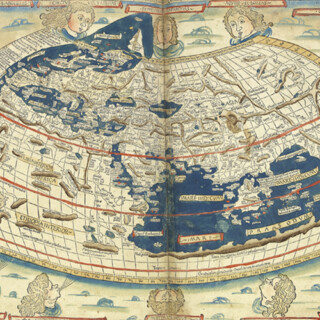
This map holds a "special place in the early cartography of Australia" (Schilder). It was issued in the eighth volume of a polyglot Bible, which came to be known as the 'Sacrae Regia', printed by Christopher Plantin, and edited by Arias Benedictus Montanus between 1569 and 1572. The bible, with text in Hebrew, Greek, Latin, and Syriac, was dedicated to and largely paid for by King Philip II of Spain. Tragically, a large proportion of the entire printing of the final eighth volume was lost at sea on its way to Spain, so the first issue is very rare.
Based on the cartography of Giacomo Gastaldi, the map purports to show how Noah's three sons repopulated the earth apres le deluge, but also includes a wonderful and mysterious anomaly: a landmass in the region and rough shape of northern Australia but not included in official Dutch records, until it was "sighted" during the voyage of the 'Dufykin' in 1606, therefore making a tantalizing claim for the "inclusion of Portuguese discoveries along the northern coastline, without any hypothetical southern land mass" (Clancy).
The current example is the second issue of this double-hemisphere map, with no text on the verso, and the word "Gentes" added to the panel of text lower left.
The mapmaker
Benedictus Arias Montanus (1527-1598), a scholarly Orientalist, was commanded by King Philip II of Spain, in 1568, to supervise and edit a new polyglot edition of the Bible. Arias included parallel Hebrew text with a translation by Leon de Castro, a fellow professor of Oriental languages at Salamanca. de Castro denounced Arias to the Spanish Inquisition for "having altered the Biblical text, making too liberal use of the rabbinical writings, in disregard of the decree of the Council of Trent concerning the authenticity of the Vulgate, and confirming the Jews in their beliefs by his Chaldaic paraphrases" (Rudge).
Arias was eventually freed of the charges in 1580, and thereafter mostly retired to his hermitage, but accepted the post of royal chaplain, looked after the Escorial library, and resumed his teaching of Oriental languages.