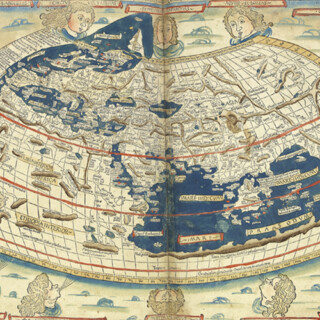
Waldseemuller's Ptolemaic map of the world from the "most important of all the Ptolemy editions" (Streeter). A "bold woodcut on the traditional modified conical projection with all regions above 65 degrees north (just north of the British Isles) covered by the inscription "Mare Congelatum" or "Frozen sea". The continents represented follow the Ptolemaic outline, although the woodcutter has not felt he could sustain the concept of a land-locked Indian Ocean, and so has omitt...
Waldseemuller's Ptolemaic map of the world from the "most important of all the Ptolemy editions" (Streeter). A "bold woodcut on the traditional modified conical projection with all regions above 65 degrees north (just north of the British Isles) covered by the inscription "Mare Congelatum" or "Frozen sea". The continents represented follow the Ptolemaic outline, although the woodcutter has not felt he could sustain the concept of a land-locked Indian Ocean, and so has omitted the strip of land normally linking southern Africa to Asia. The map itself is bordered by the usual markings of latitude and longitude and the climates. Outside this is a vigorous surround of clouds with twelve characteristic windheads representing the classical winds blowing from each direction. Visually, it is one of the most attractive Ptolemaic world maps produced" (Shirley).
The 1513 edition of Ptolemy's 'Geographia' was prepared by Martin Waldseemuller using the translation of Mathias Ringmann, and is one of the most important editions of Ptolemy, containing many new regional maps: twenty new maps based on contemporary knowledge "unlike many of the alleged "new" maps produced by earlier editors, [they] contained a great deal of new information, and in nearly every case they were decided improvements over anything that had been previously offered..." ('The World Encompassed', 56), were included in addition to the traditional body of twenty-seven Ptolemaic maps derived from the 1482 Ulm edition.
Martin Waldseemüller (1470-1521) was a German scholar and cartographer. He studied under Gregor Reisch at the University of Freiburg, and then moved to Basel in the late 1490s, where he met the printer Johannes Amerbach. In 1506 he moved to Saint-Dié in Lorraine, where Duke René II had established a humanist academy, the Gymnasium Vosagense. There he read about Amerigo Vespucci's voyage to the Americas, and Portuguese accounts of circumnavigating Africa. Together they proved that the Indian Ocean was not landlocked. He and his colleagues decided to create a map which compared Vespucci's geographical information with Ptolemy's, along with an explanation of why they had deviated from Ptolemy's precepts.
That work, 'Cosmographia introductio', was published in 1507. It contains the first printed instance of the name 'America' being applied to the discoveries over the Atlantic: "The fourth part of the earth, we have decided to call Amerige, the land of Amerigo we might even say, or America because it was discovered by Amerigo". The book was accompanied by a set of small woodcut map gores, the first known printed gores for a terrestrial globe ever made, which showed a landmass meant to represent South America labelled as 'America'. The globe gores were a companion to the 'Universalis cosmographia', the great world map in twelve sheets by Waldseemüller. It was unusually large for a woodcut map, and drawn using an adaptation of the second method of projection advocated by Ptolemy. It shows the Americas as one contiguous continent, and was the first map to give this name to the new discoveries.