Histoire de la navigation de Jean Hugues de Linschot Hollandois: aux Indes Orientales
contenant diverses descriptions des lieux jusques à présent descouverts par les Portugais, observations des coustumes et singularitez de delà et autres déclarations, avec annotations de B. Paludanus,... sur la matière des plantes et espiceries, item quelques cartes géographiques et autres figures. Troixiesme édition augmentée...
Chez Evert Cloppenburgh, Marchand libraire, demeurant sur le Water à la Bible Doree,
1638.
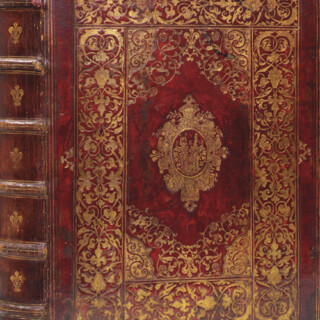
Third edition with French text. Folio (302 by 195mm). Three parts in one volume. Engraved title-page, half-page portrait of Linschoten, two further title-pages, six double-page folding maps, and 36 double-page plates; magnificent contemporary binding of French red panelled morocco, gilt, decorated with fillets and fleur-de-lis, with the armorial supra-libros of an earl's coronet and monogram "SX" on the front cover, superb matching doublures, and highly decorative pull paste paper with impressed decoration.
One of the most important of all travel books, Linschoten's was the first printed work to include precise sailing instructions for the East Indies. Its exposition of a route to the south of Sumatra through the Sunda Strait allowed Dutch and, later, English merchants to circumvent the Portuguese stranglehold on passage, and, therefore, trade, to the East through the Straits of Malacca. This enabled the British East India Company and the Dutch East India Company to set sail f...
One of the most important of all travel books, Linschoten's was the first printed work to include precise sailing instructions for the East Indies. Its exposition of a route to the south of Sumatra through the Sunda Strait allowed Dutch and, later, English merchants to circumvent the Portuguese stranglehold on passage, and, therefore, trade, to the East through the Straits of Malacca. This enabled the British East India Company and the Dutch East India Company to set sail for the Spice Islands and, ultimately, China and Japan, and was of such economic utility that, according to Church, and others, "it was given to each ship sailing from Holland to India" and soon became "the navigator's vade mecum for the Eastern seas" (Penrose).
"This important work contains all the knowledge and learning related to the East and West Indies and navigations to those parts that was available at the end of the sixteenth century. It was held in such high esteem that for nearly a century a copy was given to each ship sailing to India as a guide to the sailing directions. The fact that most copies were in continual use is in no doubt the reason that fine copies, especially with all correct plates and maps, are so very rare" (Hill).
This French language edition consists of three books. The first book concerns the East Indies and East Africa, including regions as far east as Japan. Klooster describes the work as "a magnificent panorama of pictures and maps of the non-European world … [that] contained so much detailed and accurate information about shipping lanes, winds, and currents, that seafarers could use it virtually as a handbook". The work is also especially valuable for its eyewitness account of India, termed by Lach "the most important of the firsthand accounts published independently of the great travel collections". He further states that Linschoten's description of Goa is "one of the most original and reliable narratives prepared during the sixteenth century on life at the hub of Portugal's Eastern empire and still is regarded as one of the best sources for Goa's history at the peak of its glory … [The] maps, which are much better and more detailed than earlier printed maps, were clearly derived from the latest and best Portuguese charts of the Eastern oceans and sea coasts".
The second book, here as 'Le grand routier de mer … Continant une instruction des routes & cours qu'il convient tenir en la Navigation des Indes Orientales, & au voyage de la coste du Bresil, des Antilles, & du Cap de Lopo Gonsalves'. It describes the navigation of the coasts of West Africa around the Cape of Good Hope to Arabia, together with the coasts of the New World. It includes a real "roteiro" after the Portuguese Royal pilot Diego Alfonso, containing sailing directions from Portugal to India, and instructions for sailing from island to island in the East Indies.
The third book, 'Description de l'Amerique & des parties d'icelle, comme de la Nouvelle France, Floride, des Antilles, Iucaya, Cuba, Jamaica, &c.' gives an account of America and the African coast.
Jan Huyghen van Linschoten (1563-1611) Linschoten was a native of Enkhuizen who travelled to Spain in 1576 to join his two elder brothers. The family moved to Lisbon during the troubles of 1581. Through family contacts the young Linschoten became attached to the retinue of Vincente de Fonseca as he was sent to Goa as Archbishop. Arriving in September 1583 he spent time travelling through Malabar and Coromandel. All the while he compiled a secret account of his findings. In 1586 Dirck Gerritsz (1544-1604) passed through Goa returning from Japan having also been to China. He was probably the first Dutchman to visit the former. He passed much of his knowledge to Linschoten.
The archbishop returned to Europe in 1587 to report to Philip II but Linschoten remained. Expecting his return, he later found out that he had died at sea. He resolved to return himself and through the auspices of Dutch traders such as the Fuggers and Welsers in India obtained the position of a factor on one of their returning vessels in 1589. He remained on the island of Terceira in the Azores for two years and made his way back to Holland in September 1592. He continued to gather further information from Dutch sailors even accompanied William Barentsz's second voyage to the Kara Sea in 1594-95. In 1594 he received permission to publish his work. The 'Itinerario' was an instant success and combined his first-hand accounts with translations of Portuguese and Spanish documents.
This is the third French language edition of Linschoten's navigation. The first was published in 1610, then present work is a fine and fresh example of the third edition in French, with commentaries by B. Paludanus reprinted from the edition of 1619. "Fine copies of this work with all the maps and plates are extremely rare" (Church).
bibliography:
bibliography:
Armorial.bibsoc.org.uk - CAP004; Church 252; JCB (3) II:271; Klooster, 'Dutch in the Americas', p. 8 & Catalogue Item 5; Palau 138584; LOC European Americana 638/67; David E. Parry, 'The Cartography Of The East Indian Islands', pp. 84–85; Lach, 'Asia In The Making Of Europe', Volume 1, pp.198–204 & 482–489; Sabin 41373; Shirley 187; Tiele 686–88.
provenance:
provenance:
Provenance: from the library of the Earls of Sussex, probably acquired by Algernon Capel / Capell, 2nd Earl of Essex, Viscount Maldon and Baron Capell of Hadham (1670-1710), who following his father, Arthur Capel / Capell, 1st Earl of Essex's example, built a distinguished library of important atlases, voyages and travels, and natural history, at Cassiobury, near Watford, about which John Evelyn wrote, on 18th April, 1680: "The library is large, and very nobly furnished, and all the books are richly bound and gilded"; with the supra-libros of Capell-Coningsby, George, 5th Earl of Essex (1757-1839) on the front cover.
![[DOIN, Ochikochi (i.e. Fujii HANCHI), after] Bunken Edo oezu.](https://i0.wp.com/crouchrarebooks.com/wp-content/uploads/2026/02/24668_1H.jpg?fit=4000%2C3313&ssl=1) The dawning of the age of Bunka-Bunsei
1 × £20,000
The dawning of the age of Bunka-Bunsei
1 × £20,000 Early Stuart London
1 × £70,000
Early Stuart London
1 × £70,000


 Early Stuart London
