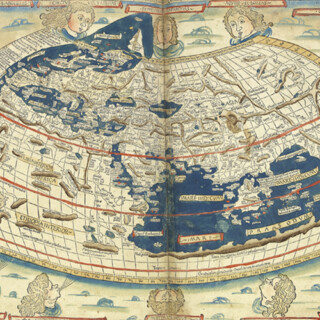
Rare Maps
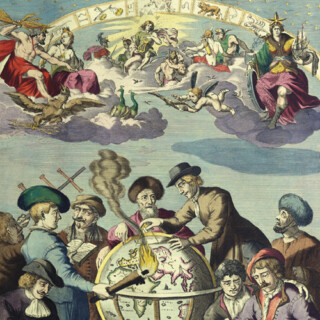
Rare Atlases
Rare Books
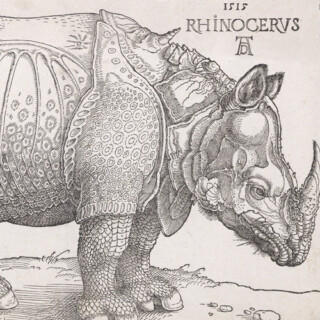
Rare Prints
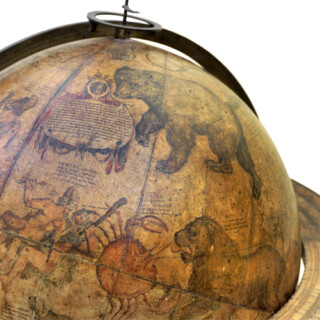


In this catalogue we focus on the early modern world – roughly the fifteenth to seventeenth centuries – when exploration, celestial observation, and mathematical map-making transformed how the globe was measured and imagined. In its pages you’ll find charts and books that trace that shift, from tentative coastlines to confident global projections, showing how paper, ink, and ingenuity turned unknown oceans into navigable space on both the library shelf and in the human mind.

Cities, like people, are full of contradictions. They promise order but grow through chaos. They are built on careful plans, yet shaped by imagination and memory. Cities, like dreams, a collaboration between Daniel Crouch Rare Books and Michael Hoppen Gallery for TEFAF Maastricht 2026, explores how cities have been pictured and understood across three centuries - how they have been drawn from above and experienced from within.
The exhibition brings two very different ways of seeing together. Monumental eighteenth‑century town plans - made at a time when faith in reason and measurement was at its height - are shown next to Sohei Nishino’s large‑scale photographic dioramas, dreamlike reconstructions of the same cities created from thousands of individual photographs. These pairings reveal what the city has always been: both a system and an emotion, something that can be mapped and yet never truly contained.

We are delighted to present The Roger Cline Collection - The story of London told in 40,000 books, maps, and prints spanning 400 years - the largest such collection in private hands.

Rosie and David Temperley believe that “communication, cooperation, and creativity” are the three key tenets for social cohesion, and life.
The Temperley Collection, their vast accumulation of books and ephemera, acquired over more than sixty years, is a blinding reflection of this bright ideal, illuminated via the ingenuity of a myriad of papery arts. The result is a cornucopia of marvels and delights that (literally) spring, bounce, twist, turn, fold, flap and flip – off, on and through the pages of thousands of books, cards, prints, and toys.
Over the course of the 500 years that the Temperley Collection spans, some of the most enlightened minds have used these methods to communicate the scientific and religious mysteries of our heavens and earth. Above all, the Temperley Collection practices what it preaches: it is a library that refuses to stay put on the shelves; it is an experience which demands immersion and participation.

The discovery and exploration of Australia has long been framed as both an act of chance and of growing curiosity, shaped by the vast seas of the southern hemisphere and guided by the faint patterns of the stars.
The 111 maps and books of the Michael and Wendy Brown Collection tell this story from the creatures of ancient European myth, via the monsters of colonialism, to the behemoth of globalisation and modern multi-cultural Sydney.

Since early modern times, the artistic, printing and publishing world, including cartography, has on occasion, provided women with a means of agency, expression, and visibility. The women cartographers in this selection have, against the odds, been able to publicly claim their work.

It is with great pleasure that Altea Gallery and Daniel Crouch Rare Books bring you this joint catalogue of the manuscript and printed archive of the world-renowned maritime chart publisher Imray, Laurie, Norie and Wilson Ltd.
The collection is a unique portrait of the Enlightenment world at the turn of the eighteenth century.

Daniel Crouch Rare Books is proud to present a collection of playingcards and related items that are a store of artistic, political, industrial and cultural history spanning seven centuries and five continents. These palmsized pieces of paper have the power to enrich, educate, advertise or entertain.
The artistic and technical innovations of the generations of card-makers represented here have ensured that, even if you get dealt a bad hand, you are still holding good cards.

Whether alone or in teams, for pleasure or profit, sporting or seated, games have been an ever-present feature of every civilization. During the eighteenth century, not only were industrial advances making large-scale printing easier, but they were also generating something that had never before been available to the majority of society: leisure time. Paired with growing literacy rates across society and greater understanding of the importance of childhood education, this gave birth to a wave of new and unique games, especially in the form of jigsaw puzzles, playing cards, and board games.

If journalism is, as they say, the first draft of history, then perhaps photography is the raw material of memory; in the sense not just of personal mementoes (though that’s often the way photographs start out), but also of shared recollection. And that sort of collective remembering is, in turn, the stuff of history’s sister, culture, and of identity.

Maps are scientific instruments. They offer proof of truth. They portray measured relationships between objects and ideas. To achieve this, however, maps must reduce, omit, and distort a three-dimensional world onto a flat piece of paper. This is the paradox of cartography: to tell the truth, a map must lie.

In antiquity, the earliest geographers and cartographers hypothesised a southern landmass to balance out the northern hemisphere, and when, in the second century, Ptolemy asserted that the Indian Ocean was bounded by land to the south, the legend of a terra australis incognita was born.
