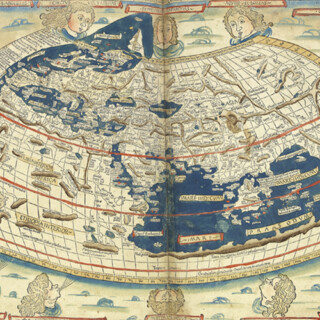
One of the earliest printed maps in an edition of Ptolemy to include the name "America" (Shirley 48).
First published in 1522, this example is an early issue, in which the near horizontal crack, emerging from the righthand margin near the equator, is very short, and before the new title-banner, 'Tabu. Totius Orbis', was added.
In this map of the modern world "Europe is very crudely drawn with England and Scotland reverting to separate islands. India, w...
One of the earliest printed maps in an edition of Ptolemy to include the name "America" (Shirley 48).
First published in 1522, this example is an early issue, in which the near horizontal crack, emerging from the righthand margin near the equator, is very short, and before the new title-banner, 'Tabu. Totius Orbis', was added.
In this map of the modern world "Europe is very crudely drawn with England and Scotland reverting to separate islands. India, which was well defined on Waldseemuller's great 'Carta Marina' of 1515 – to be re-issued by Fries himself in 1525 – has become a confusing double peninsula, with the largest southward-extending land mass being east of the Ganges delta. South America is shown in part, with the shape of its western coastline inserted more by intuition than by factual report. Magellan had indeed reached the Pacific via Tierra del Fuego in 1519 but his surviving ship did not reach the ports of Europe until September 1522, several months after publication of Fries' work" (Shirley 48).
Issued in the first edition of Ptolemy's geography to be edited by Michael Villanovanus, better known as Servetus (1511-1553), born at Villanueva, in Aragon, Spain. While working as an editor for the publisher Trechsel he wrote the preface and many of the modern descriptions for the versos of the celebrated maps. He also edited a second edition printed at Vienne in the Dauphiné, in 1541. For his writings against the Holy Trinity and infant baptism Servetus was burnt at the stake in 1553. However there were forty counts of heresy against him, including the offence of having asserted, in the text accompanying map 41 (The Holy Land), that Palestine was not as fertile as it was generally believed. Many copies of the book were burned with him on the orders of John Calvin, although the offending passage was not actually written by Servetus, and had appeared previously in the 1522 and 1525 editions, and was pointedly omitted from the second edition of 1541.
The maps of the 1522 edition of Ptolemy's geography were cut in wood by Laurent Fries after the original 1513 maps of Martin Waldseemuller (1470-1520). Fries was originally a physician, "at a succession of places in the Alsace region, with a short spell in Switzerland, before settling in Strasbourg, in about 1519. By this time, he had established a reputation as a writer on medical topics, with several publications already to his credit. Indeed, it was thus that Fries met the Strasbourg printer and publisher Johann Grüninger, an associate of the St. Die group of scholars formed by, among others, Walter Lud, Martin Ringmann and Martin Waldseemuller. It would seem that Gruninger was responsible for printing several of the maps prepared by Waldseemuller, and for supervising the cutting of the maps for the 1513 edition of Ptolemy, edited by the group.
The mapmaker Laurent Fries had studied medicine at the universities of Pavia, Piacenza, and Montpellier, before establishing himself as a physician in the Alsace region and Switzerland, and eventually settling in Strassburg, in about 1519. There he met the printer and publisher Johann Grüninger, who worked with the Saint-Dié group of scholars, which included Walter Lud, Martin Ringmann, and Martin Waldseemüller. Grüninger printed several maps prepared by Waldseemüller, and supervised the cutting of the woodblocks for his 1513 edition of Ptolemy's 'Geographia'.
Fries's first venture into mapmaking was probably in 1520, when he assisted Petrus Apianus in publishing a reduced version of Martin Waldseemüller's wall-map of the world, first published in 1507. The engraver of the map was almost certainly Laurent Fries, whose initials appear on either side of the garland at the lower right corner. The map, 'Tipus Orbis Universalis Iuxta Ptolomei Cosmographi Traditionem Et Americ Vespucii Aliorque Lustrationes A Petro Apiano Leysnico Elucubrat. An.o Dni MDXX', was issued in an edition of Julius Caius Solinus's 'Polyhistor', a third century compilation of history and geography, based largely on the works of Pliny and Pomponius Mela. It may also have been issued separately.
Next, in 1522, Fries and Grüninger worked together on Fries's own edition of Ptolemy's 'Geographia', in which nearly all the maps were after those in Waldseemüller's atlas. However, they added three new maps, of the world, of China and Japan, and Southeast Asia, as here. Laurent Fries's 1522 edition of Ptolemy's 'Geographia' is exceedingly rare, suggesting that the work was not initially commercially successful. Grüninger reissued the geography in 1525.
bibliography:
bibliography:
Literature: Shirley, 'The mapping of the world: early printed world maps, 1472-1700', 48; Suarez, 'Early Mapping of Southeast Asia', page 96, image 50.