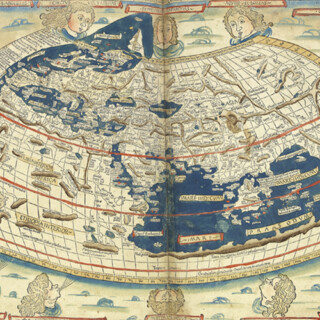
The world map from the 'Liber Chronicarum', or the "Nuremberg Chronicle", a history of the world, published the year that Columbus returned to Europe after discovering America, while in search of Paradise, predicted by most medieval commentators to be in the farthest reaches of the earth, i.e. eastern Asia.
Geographically, the map is very similar to the small map added to a new edition of Pomponius Mela's 'Cosmographia' (1482), published by Erhard Ratdolt. It "is...
The world map from the 'Liber Chronicarum', or the "Nuremberg Chronicle", a history of the world, published the year that Columbus returned to Europe after discovering America, while in search of Paradise, predicted by most medieval commentators to be in the farthest reaches of the earth, i.e. eastern Asia.
Geographically, the map is very similar to the small map added to a new edition of Pomponius Mela's 'Cosmographia' (1482), published by Erhard Ratdolt. It "is a robust woodcut taken from Ptolemy… What gives the map its present-day interest and attraction are the panels representing the outlandish creatures and beings that were thought to inhabit the furthermost parts of the earth. There are seven such scenes to the left of the map and a further fourteen on its reverse… among the scenes are a six-armed man, possibly based on glimpses of a file of Hindu dancers so aligned that the front figure appears to have multiple arms" (Shirley). However, these images are balanced by more familiar and reassuring ones, as the map itself is dominated by the figures of Shem, Japhet and Ham, the sons of Noah whose descendants were believed to have re-populated the earth after the biblical Flood.
Generally, the map follows the classical belief of a landlocked Indian Ocean, with a distorted but clear depiction of the lands of the Far East, and the major innovation of the map is the inclusion of Portuguese discoveries on the west coast of Africa, accounting for the much longer coastline of the continent in comparison to previous Ptolemaic maps. In addition, this map also has a large unidentified island off the west of the continent, perhaps referencing Alvise Cadamosto's discovery of the Cape Verde Islands in 1456.
The mapmakers This world map is now thought to be the work of Nuremberg physician, humanist, and traveller, Hieronymous Munzer (1437-1508). A friend of Martin Behaim, the maker of world's oldest globe, Munzer also contributed to the text of the Nuremberg Chronicle, the magnum opus of D. Hartman Schedel (1440-1514), a physician, an important Humanist, and book collector. Schedel's comprehensive library, one of the largest personal libraries in late medieval Europe, eventually contained over three hundred manuscripts, and several hundred printed books. first came into the possession of Johan Jacob Fugger, of the Augsburg family of bankers, and patron of the "Fugger Binder", in 1552, and was afterwards obtained by Duke Albert V of Bavaria (1550–1579) for the ducal, now royal, library at Munich.
However, Schedel is best known as the compiler of the famous "Nuremberg Chronicle", the Registrum huius operis libri cronicarum cum figuris et ymagibus ab inicio mundi (1493). This is an illustrated chronicle of the history of the world, from Creation to 1492. The book was printed and published by two other Nuremberg citizens, Sebald Schreyer and Sebasitian Kammermeister, and illustrated by Wilmelm Pleydenwurff and Michael Wolgemut.
Educated at Leipzig University from 1456 – 1460, Schedel initially pursued a legal career, while simultaneously taking instruction from humanistic Pieter Luder. He followed Luder to Padua in 1463, where he changed tack, and pursued medicine. In 1472, he became a physician working in Bavaria. By 1481, he was at Nuremberg where he remained until his death.
bibliography:
bibliography:
Literature: Clancy, 'So Came They South', pages 9-11; Shirley, 'The mapping of the world: early printed world maps, 1472-1700', 19; Wilson, 'The making of the Nuremberg Chronicle' 1976, pages 98-122.
 Rare Roger Rea edition of Speed’s map of Westmorland
1 × £850
Rare Roger Rea edition of Speed’s map of Westmorland
1 × £850 Speed’s battle map
1 × £1,500
Speed’s battle map
1 × £1,500![SPEED, John [Derbyshire] Darbieshire described](data:image/svg+xml,%3Csvg%20viewBox%3D%220%200%203500%202721%22%20xmlns%3D%22http%3A%2F%2Fwww.w3.org%2F2000%2Fsvg%22%3E%3C%2Fsvg%3E) Rare Roger Rea edition of Speed’s map of Derbyshire
1 × £900
Rare Roger Rea edition of Speed’s map of Derbyshire
1 × £900 Speed’s battle map
 ![SPEED, John [Derbyshire] Darbieshire described](https://i0.wp.com/crouchrarebooks.com/wp-content/uploads/2025/03/1781_1H.jpg?fit=3500%2C2721&ssl=1) Rare Roger Rea edition of Speed’s map of Derbyshire
Rare Roger Rea edition of Speed’s map of Derbyshire