Orbis Terrae Compendiosa Descriptio Quam ex Magna Universali Gerardi Mercatoris.
Domino Richardo Gartho, Geographic ac ceterarum bonarum artium amatori ac fautori summo, in veteris amicitie ac familiaritatis memoria Rumoldus Mercator fieri curabat A.o M.D. Lxxxvii.
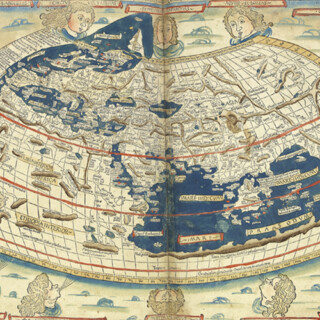
This double-hemisphere map of the world is a reduced version of Gerard Mercator's revolutionary wall map of the world (1569), and was first published in Strabo's '…Geographicarum libr XVII', with text beneath the map headed "Lectori S.P.", and without text on the verso. It may have also been published separately, and in the final part of Mercator's atlas, before being included in Rumold Mercator's complete five-volume edition of the atlas from 1595. However, the Mercator fa...
This double-hemisphere map of the world is a reduced version of Gerard Mercator's revolutionary wall map of the world (1569), and was first published in Strabo's '…Geographicarum libr XVII', with text beneath the map headed "Lectori S.P.", and without text on the verso. It may have also been published separately, and in the final part of Mercator's atlas, before being included in Rumold Mercator's complete five-volume edition of the atlas from 1595. However, the Mercator family were beaten to the post, in popularizing (and capitalizing on) this modern world view, by Abraham Ortelius, who included it as a simplified single sheet map in his atlas of the world, 'Theatrum Orbis Terrarum' (1570).
California shown as part of the mainland, there is the distinctive bulge in South America, and the kingdoms of Beach, Lucach and Maletur are shown as part of the mythical southern continent "Terra Australis", which is shown as an entirely separate landmass: it "wraps around the fullest expanse of the southern latitudes possible, save for New Guinea, which is correctly shown as a separate island. 'Terra Australis' has, in addition, become a dumping ground for errors. It harbours a realm of parrots, 'Psittacorum regio', and serves as the refuge for lands reported by Marco Polo but which have been displaced because they are now duplicated by more recent data... On the opposite pole, Mercator has depicted the Arctic according to the four-island theory previously used by Ruysch and Finaeus" (Suarez).
The mapmaker Gerard Mercator (1512-1594) would not begin his great 'Atlas' or "Cosmography" until relatively late in life. The impetus for this came when he was employed as cosmographer to Duke William IV of Kleve, in 1563. Mercator's intention was to produce a work that consisted of five books and encompassed the whole world. The first book would cover the creation; the second the heavens; the third geography; the fourth history; and the fifth chronology. He intended to draw all the maps, write all the text and cut all the plates himself. Unsurprisingly, the ambitious project would require more time than he could afford to give it, and he was only able to complete a few of the parts: the creation; the maps for Ptolemy's 'Geographia' — part of the geographical section — in 1578; and four of the modern parts. The first three were published together in 1585 and included France, the Low Countries, and Germany. The fourth part, of Italy, the Balkans, and Greece, appeared in 1589. Mercator died on December 2, 1594, leaving the responsibility for completion of the cosmography to his son Rumold. A number of maps still had to be engraved, and he employed various members of the Mercator family as engravers, including Gerard's grandsons Gerard and Michel.
Mercator's work is referred to as the first atlas, because he was the first to give a collection of curated maps this name, reflected in the famous engraved title-page showing King Atlas measuring the world with a pair of dividers. It is often wrongly thought that the word"atlas" refers to the Titan of the same name, whose punishment for fighting against the Olympian gods was to hold the heavens on his shoulders. It is instead a reference to King Atlas of the mythical Mauritania, a mathematician and philosopher who supposedly made the first celestial globe.
bibliography:
bibliography:
Literature: Clancy, 'The Mapping of Terra Australis', 5.11, and page 70; Shirley, 'The mapping of the world: early printed world maps, 1472-1700', 157; Suarez, 'Shedding the Veil', 31.