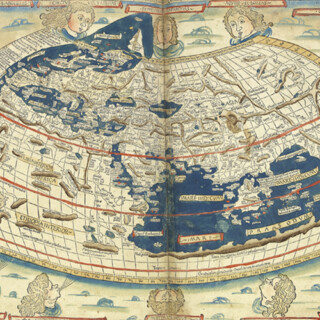
This map, prepared by Gemma Frisius, to accompany Petrus Apinanus's 'Cosmographicus liber' (1544). Frisius was an early proponent of the theory that a sea passage to the north of America existed that would allow quicker access to the Indies than the long southern route through the Strait of Magellan. He illustrates his theory in this map, which is also one of the earliest to show the entire east coast of North America. It displays the eastern side of North America as a narr...
This map, prepared by Gemma Frisius, to accompany Petrus Apinanus's 'Cosmographicus liber' (1544). Frisius was an early proponent of the theory that a sea passage to the north of America existed that would allow quicker access to the Indies than the long southern route through the Strait of Magellan. He illustrates his theory in this map, which is also one of the earliest to show the entire east coast of North America. It displays the eastern side of North America as a narrow landmass, named "Baccalearum," after the cod fisheries off the coasts of New England and Canada. The map uses Apianus's original cordiform projection, and maintains the tantalising possibility of a northwest passage to Asia over the top of north America. The map is also notable for being the first printed map to depict the Yucatán as a peninsula rather than as an island, anticipating Ruscelli's 1561 map of New Spain. Cuba and Hispaniola are shown as huge islands. Also prominent are the Mountains of the Moon, considered the source of the River Nile. The map is decorated with vignettes of animals, sailing ships and a mermaid. Signs of the zodiac and the Ptolemaic climatic zones border the map.
Zeus and Mars, wearing the coats-of-arms of Charles V, Holy Roman emperor, are shown above the map, while wind-heads at the south represent the traditionally believed plague-bearing nature of those winds. To the left of the map, "Climata Australia" appears just south of the equator. While this is technically the first appearance of "Australia" on a map, it refers to a climatic zone, rather than a landmass. Three woodcut blocks, from which the map was printed, have been identified. The current map is an impression of the first woodblock, with "Europa" at an angle and the outline of Britain without a caption. The first woodblock was known to have been sent to Paris in 1551, and new one cut for publication in Antwerp. The current example was published in Gregor Reisch's 'Margarita philosophica', Basel, 1583.
The mapmakers Petrus Apianus (1495-1552). Born in Saxony as Peter Bienewitz, he studied at the University of Leipzig from 1516 to 1519, where he adopted the Latinised version of his German name, Petrus Apianus. In 1519, he moved to Vienna, where he was part of the second Vienna school of cartography, which included Georgius Tannstetter and Johannes Cuspinianus. In 1520, assisted by Laurent Fries, Apianus created a reduced version of Waldseemuller's 1507, 12-sheet wall-map of the world, 'Tipus Orbis Universalis', on a cordiform projection. As Waldseemuller's map is known in only one example, Apianus's is the earliest obtainable map to name "America". He then moved again to Landshut, near Ingolstadt, where he produced the 'Cosmographicus liber' in 1524, an extremely popular work on astronomy and navigation which was reprinted thirty times. Based on the work of Ptolemy, it contains paper instruments called volvelles, which Apianus would use so effectively in his work that they are sometimes known as Apian wheels. In 1527, the University of Ingolstadt appointed him as a mathematics tutor and official printer. While at Ingolstadt, Apianus came to the attention of Charles V, Holy Roman Emperor, who praised his work at the 1530 Imperial Diet and granted him printing monopolies in 1532 and 1534. He continued to publish on mathematical and astronomical themes, including the only known European depiction of Bedouin constellations in his 1533 book, 'Horoscopion Apiani Generale'. In return, Apianus dedicated his most famous work to Charles in 1540: the 'Astronomicum Caesareum', a comprehensive review of contemporary astronomical knowledge, including theories from the use of solar eclipses to determine longitude to Apianus's own observation that the tails of comets always point away from the sun. He had noted this trend after an appearance of Halley's comet in 1531. It was beautifully illustrated and crammed with intricate volvelles, which could be used to calculate everything from eclipses to the hour of a baby's conception. Apianus was supposedly promised the princely sum of 3000 guilders by the Emperor in return for his work, although there is no record of whether this was ever actually paid. He was, however, made a Reichsritter or Imperial Knight, and eventually made an Imperial Count Palatine. Apianus continued to work in Ingolstadt until his death, teaching relatively little but producing work on sines, a variation on Pascal's triangle and manuals for horological instruments.
Reinerus Gemma Frisius (1508–1555). Reinerus Gemma, from Frisia (better known as Gemma Frisius) was a cartographer, astronomer, mathematician, physician, and maker of scientific instruments. He studied at the University of Louvain, and was appointed professor of medicine there, in 1541. His first work, 'De principiis astronomiae et cosmographiae' (1530), attempted to establish longitude by proposing the use of portable clocks, a then impractical theory, which would only be vindicated two centuries later. Gemma published his first edition of Apianus's 'Cosmographia' with his own 'Libellus de locorum describendorum ratione' in 1533. His 'Charta sive mappa mundi' (1540) was also included from 1544. Other works include 'De astrolabio' (1556), and his blockbuster: 'Arithmeticae practicae methodus facilis' (1540), which was reprinted more than fifty times during the sixteenth century.
Interestingly, according to Suarez, Frisius "taught a student called named John Dee, who soon became a prominent English geographer and a strong proponent of the northern route to the Indies. Dee regarded the Orient with a mystical awe, believing it to be a repository of the occult arts and the resting place of Biblical treasure. He considered the East to be the true source of all mystical knowledge, as well as wealth, wisdom, and true faith. While fastidiously keeping himself abreast of the latest geographic news and theories, he tried to reconstruct King Solomon's tracks to Ophir by using the Judeo-Christian Bible as a literal travel log. He encouraged his countrymen to try to find a northern route to the Indies but they only met with failure and in 1583 Dee ceased his study of geography".
bibliography:
bibliography:
Literature: Shirley, 'The mapping of the world: early printed world maps, 1472-1700', 82, plate 70; Suarez, 'Early Mapping of Southeast Asia', page 197, image 113.