 “Dr Livingstone, I presume?”
  “such parts of the coast of Madagascar as you may conceive not to have been accurately ascertained”
  “Fine pasture country uninhabited and considered neutral ground”
Rare Maps
Rare Atlases
Rare Books
Rare Prints


![SHARP, James; and Catherine SHARP [compiler]; Thomas JEFFERYS; William FADEN; Robert WHITWORTH; James BRINDLEY; and Ralph DODD, et al. [Composite Album of eighteenth century canal maps and ephemera]](https://i0.wp.com/crouchrarebooks.com/wp-content/uploads/2026/01/24419_1H.jpg?fit=4000%2C1492&ssl=1)
By SHARP, James; and Catherine SHARP [compiler]; Thomas JEFFERYS; William FADEN; Robert WHITWORTH; James BRINDLEY; and Ralph DODD, et al., [1697-1805]

For our inaugural catalogue we are proud to offer the Gestetner Collection of maritime atlases and voyages. Undoubtedly one of the best libraries of sea atlases in private hands, the books are remarkable both for their exceptional quality and their rarity. The Gestetner family started building a collection of maritime atlases and voyages twenty years ago to celebrate their love of sailing and the many happy times they had spent together on their various boats, all named ‘Grumpy Skipper’.

For our second catalogue, we are proud to present a selection of rare and important atlases, sea atlases, wall maps, manuscript maps, and voyages.

Welcome to the third catalogue from Daniel Crouch Rare Books. Within these pages you will find 100 plans showing London’s rapid development, from the Tudors to the Windsors. You will see London the glutton, purged by fire, the home of the rich as well as the poor, and a refuge and opportunity for strangers; a city not dissimilar to the one we inhabit ourselves.

In celebration of The European Fine Art Fair’s 25th anniversary, we areproud to present 25 spectacular items from the first four hundred years of the history of printing.

We are pleased to announce the publication of Catalogue IX, released for both the opening of our New York gallery and the inaugural TEFAF fair in New York. Fittingly, many of the items in the catalogue deal with new frontiers, from a copy of the terms of Columbus’s journey to America to a globe showing one woman’s plans for a socialist utopia on Mars.

Welcome to the fifth catalogue from Daniel Crouch Rare Books. The catalogue comprises a selection of the items that we will be exhibiting at the 26th European Fine Art and Antiques Fair in Maastricht and, as a consequence, it has an undeniably Dutch feel about it.

Catalogue VI represents something of a departure for Daniel Crouch Rare Books. In the year that marks 300 years since the passing of the Longitude Act, and the 25th anniversary of the World Wide Web, we thought it a good time to put together a collection of calculating machines from the first information revolution.

Welcome to Catalogue VII, published on our fifth anniversary. To mark this occasion we have selected from our inventory the most spectacular examples in each of the fields in which we specialise – atlases, maps, globes, voyages, and scientific instruments. Each item is distinguished by its historical interest, rarity, or beauty. The most exceptional combine all three, like the pair of Blaeu globes made for Schloss Baldern in Germany (item 46). All represent pinnacles of human achievement, created by the most gifted scholars and craftsmen of their time.

In 2011, Daniel Crouch Rare Books produced a catalogue of maps showing London from 1574 to the present day. In 2016, we return to the capital, but this time, with a catalogue of prints.

The 1531 planisphere signed and dated by Vesconte Maggiolo is a remarkable survival: a monumental early sixteenth century portolan chart of the known world, in astonishingly good condition, with rich decoration, vibrant colours, and heightened in lapis lazuli, gold, and silver.

In this catalogue we have selected 28 items – one for each of the states of the current European Union – that explore the history and idea of the European nation state. In his introductory essay Professor Colin Crouch argues that territorial sovereignty is rooted more in political expediency than in natural borders or cultural identity. Advances in mapmaking technologies not only preceded the birth of the modern European nation state, but were also necessary conditions for its creation.

Cities, like people, are full of contradictions. They promise order but grow through chaos. They are built on careful plans, yet shaped by imagination and memory. Cities, like dreams, a collaboration between Daniel Crouch Rare Books and Michael Hoppen Gallery for TEFAF Maastricht 2026, explores how cities have been pictured and understood across three centuries - how they have been drawn from above and experienced from within.
The exhibition brings two very different ways of seeing together. Monumental eighteenth‑century town plans - made at a time when faith in reason and measurement was at its height - are shown next to Sohei Nishino’s large‑scale photographic dioramas, dreamlike reconstructions of the same cities created from thousands of individual photographs. These pairings reveal what the city has always been: both a system and an emotion, something that can be mapped and yet never truly contained.
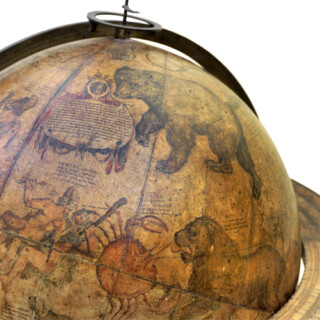
![BLAEU, Willem Janszoon [Pair of nine-inch table globes].](https://i0.wp.com/crouchrarebooks.com/wp-content/uploads/2026/03/35304_1H.jpg?fit=4000%2C2694&ssl=1)


We are delighted to present The Roger Cline Collection - The story of London told in 40,000 books, maps, and prints spanning 400 years - the largest such collection in private hands.

Rosie and David Temperley believe that “communication, cooperation, and creativity” are the three key tenets for social cohesion, and life.
The Temperley Collection, their vast accumulation of books and ephemera, acquired over more than sixty years, is a blinding reflection of this bright ideal, illuminated via the ingenuity of a myriad of papery arts. The result is a cornucopia of marvels and delights that (literally) spring, bounce, twist, turn, fold, flap and flip – off, on and through the pages of thousands of books, cards, prints, and toys.
Over the course of the 500 years that the Temperley Collection spans, some of the most enlightened minds have used these methods to communicate the scientific and religious mysteries of our heavens and earth. Above all, the Temperley Collection practices what it preaches: it is a library that refuses to stay put on the shelves; it is an experience which demands immersion and participation.
![[DOIN, Ochikochi (i.e. Fujii HANCHI), after] Bunken Edo oezu.](https://i0.wp.com/crouchrarebooks.com/wp-content/uploads/2026/02/24668_1H.jpg?fit=4000%2C3313&ssl=1)
By [DOIN, Ochikochi (i.e. Fujii HANCHI), after], c.1803.

![PTOLEMAEUS, Claudius [Untitled World Map].](https://i0.wp.com/crouchrarebooks.com/wp-content/uploads/2026/03/24625_2H.jpg?fit=4000%2C2882&ssl=1)
![FLORIANO, Antonio [Untitled Map of the World].](https://i0.wp.com/crouchrarebooks.com/wp-content/uploads/2025/12/24612_1H.jpg?fit=4000%2C2412&ssl=1)
