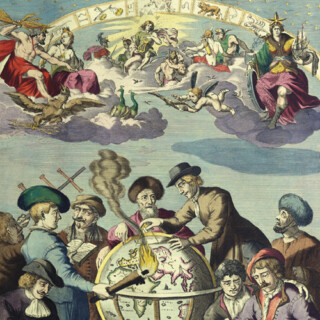
The cartouche at the centre of this chart says it all. An allegorical scene shows the Dutch and the British liberating the lands of the Pacific arena, including rather ambitiously, the Americas, which take up nearly the whole of the eastern half of the chart, from the Spanish. To make the point further, the chart is filled with galleons firing canon at each other.
At the time the Van Keulen family published this chart, Spain controlled the Philippines (1565–1898)...
The cartouche at the centre of this chart says it all. An allegorical scene shows the Dutch and the British liberating the lands of the Pacific arena, including rather ambitiously, the Americas, which take up nearly the whole of the eastern half of the chart, from the Spanish. To make the point further, the chart is filled with galleons firing canon at each other.
At the time the Van Keulen family published this chart, Spain controlled the Philippines (1565–1898); Palau (1574–1899); the Marianas (1667–1898 or 1899); and had their sights set on the Carolines (1686–1899). Together with the Spanish West Indies, these islands were administered through the Viceroyalty of New Spain based in Mexico City.
The Treaty of Tordesillas (1494) had established a line of demarcation at 370 leagues west of the Cape Verde Islands, carving the world in two between Spain and Portugal, pole to pole. Spain had gained everything to the west, which was most of the Americas, except for the Brazilian bulge of South America (omitted from this chart); and Portugal, could claim lands to the east, including Africa…
BUT,… where should the territories meet on the other side of the earth?
Charles V of Spain had a good idea: he married Isabella of Portugal in 1526, and signed a new treaty with Portugal, creating an antimerdianal line, in Zaragoza in 1529. Portugal "paid Spain 350,000 ducats for the Moluccas, and, to prevent further Spanish encroachment, the new line of demarcation was established almost three hundred leagues (or 17°) to the east of these islands. Portugal got control of all of the lands to the west of the line, including Asia, and Spain received most of the Pacific Ocean. Spain's argument that the Treaty of Tordesillas divided the world into two equal hemispheres was not recognized in the Treaty of Saragossa: Portugal's share was approximately 191°, whereas Spain's was roughly 169°, with a variation of about ±4° owing to the uncertainty of the location of the Tordesillas line. Spanish interest in the Philippines, shown by the new treaty to be on the Portugal side of the line, would become an issue in the later decades of the sixteenth century" (Princeton University online).
Second issue, with "Compagnies Land" added upper left.
The mapmaker Johannes van Keulen (1654-1715) established a bookselling and instrument making business in Amsterdam in 1678, and by 1680 he had obtained a privilege from Holland and West Friesland to print pilot guides and sea atlases. His first major production was the atlas 'Nieuwe Lichtende Zee-Fakkel', illustrated by Jan Luyken and with maps by Claes Jansz Vooght. Five volumes were published between 1681 and 1684.
The van Keulen cartographic dynasty continued for nearly two centuries. Johannes's son, Gerard (1678–1726), produced new editions of his father's works and made numerous manuscript charts. He was appointed hydrographer to the Dutch East India Company (VOC) in 1706. His grandson, Jan II van Keulen (1704–1770) took over the business in 1726, and published a new edition of the Asian volume of the 'Zee-Atlas'. He was appointed chartmaker to the VOC in 1743, setting an official seal on a well-established relationship that was to last until the company dissolved in 1799.
bibliography:
bibliography:
Literature: Clancy, 'The Mapping of Terra Australis', 7.4; McLaughlin, 'The Mapping of California as an Island'; Suarez, 'Early Mapping of the Pacific', 88; Tooley, 'The Mapping of Australia', 796.