Abel Tasman's celebrated map of "Hollandia Nova – Terra Australis", published in the second edition of John Harris's 'Navigantium atque Itinerantium Bibliotheca. Or, a Complete Collection of Voyages and Travels', first published without Bowen's maps in 1705. The first map dedicated to Australia in English, having first been published in Melchisedec Thevenot's 'Relations de Divers Voyages Curieux qui n'ont point esté publiées, ou qui ont esté traduites d'Hacluyt, de Purchas ...
Abel Tasman's celebrated map of "Hollandia Nova – Terra Australis", published in the second edition of John Harris's 'Navigantium atque Itinerantium Bibliotheca. Or, a Complete Collection of Voyages and Travels', first published without Bowen's maps in 1705. The first map dedicated to Australia in English, having first been published in Melchisedec Thevenot's 'Relations de Divers Voyages Curieux qui n'ont point esté publiées, ou qui ont esté traduites d'Hacluyt, de Purchas et d'autres voyages Anglais, Hollandais, Portugais, Allemands, Espagnols, et de quelques Persans, Arabes et auteurs orientaux' (1663). Based on Joan Blaeu's wall map of Asia and Australia, 'Archipelagus Orientalis, sive Asiaticus' (1659), Australia's "birth certificate", and the progenitor of the shape of the nation for 100 years.
The mapmakers Abel Jansz. Tasman (c1603-1659), was the first European explorer to reach and map the coastlines of Tasmania and New Zealand. After a series of shipwrecks had revealed some of the western coast of Australia, he was chosen by Anthony van Diemen, governor-general of the Dutch East Indies, to lead a voyage of discovery to the south, in 1642. The intention was to find a sea route south of Nuyts land, and east across the Pacific to South America. In his ships, the 'Heemskerck' and 'Zeehaen', over a course of ten months, Tasman mapped the coast of southwest Tasmania, the west coast of New Zealand, and the island groups of Tonga and New Guinea. A second voyage, in 1644, Tasman and crew surveyed the southwest coast of New Guinea, and much of Australia's northern coastline, as here.
Although the longed for southern sea route was not found,… the easterly's were too strong, Tasman was awarded the rank of commandeur on his return, and a pay rise was backdated to the beginning of his first voyage. Subsequently, Tasman was "appointed to the Council of Justice at Batavia. In mid-1647 he was sent on a mission to the King of Siam and was granted precedence over all Dutchmen in the kingdom. After that mission, he was given command of a fleet of eight vessels which sailed in May 1648 against the Spaniards. His conduct in this operation was unsatisfactory and, after his return in January 1649, proceedings were taken against him for having, when inflamed by liquor, treated one of his sailors in a barbarous way; as a result, he was removed from office during the governor-general's pleasure. He was formally reinstated in January 1651, but not long afterwards retired from the service and became a merchant in Batavia. He died there in affluent circumstances in 1659" (Forsyth).
Eventually, geographer to George II, from about 1747, also possibly (according to Chubb), geographer to Louis XV of France, Emanuel Bowen (c1693-1767) was originally apprenticed to Charles Price in 1709. Price, a renowned globe and instrument maker, member of the Merchant Taylors Company, had in turn had been apprenticed to John Seller senior.
Amongst Bowen's first work were maps for George Willdey's 'Atlas of the World' (1717). There followed a period during which he engraved charts for some of the leading hydrographers of his day: Joseph Avery, Samuel Fearon and John Eyes, Nicholas Dobrée, and Murdoch Mackenzie. He also produced a prodigious number of maps for British periodicals. Significant maps that he subsequently published under his own name, include: 'A new and accurate map of South Wales … delineated from an actual survey and admeasurement by Eman. Bowen', (1729), a large six-sheet map, sold by subscription, mostly to local wealthy landowners.
In the early 1730s, Bowen took on two apprentices, Thomas Kitchin and Thomas Jefferys, both of whom would become pre-eminent map makers in their own right. There followed some large-scale maps of Norfolk and Huntingdonshire, 'A new and accurate map of England and Wales' (1734), maps for John Harris's 'Navigantium atque itinerantium bibliotheca' (1744–8), as well as numerous atlases, including Bowen's 'Complete System of Geography' (1744–7), and 'Complete Atlas' (1752).
bibliography:
bibliography:
Literature: Clancy, 'The Mapping of Terra Australis', 6.25; Clancy, 'So Came They South', pages 136-138; Forsyth, 'Australian Dictionary of Biography', online; Schilder, 'Australia Unveiled', 87; Tooley, 'The Mapping of Australia', 241.
![HOLLAR, W[enceslaus] [after] Ant[hony] van DYCK Carolus II DG Magna Brittania Fra et Hibernia Rex](https://i0.wp.com/crouchrarebooks.com/wp-content/uploads/2025/03/18289_1H.jpg?fit=2348%2C3284&ssl=1) The young Charles II
1 × £400
The young Charles II
1 × £400 Bordone’s Isolario in contemporary binding
1 × £40,000
Bordone’s Isolario in contemporary binding
1 × £40,000
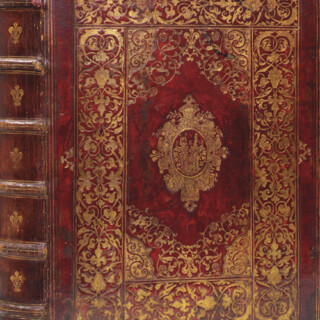


 Bordone’s Isolario in contemporary binding

