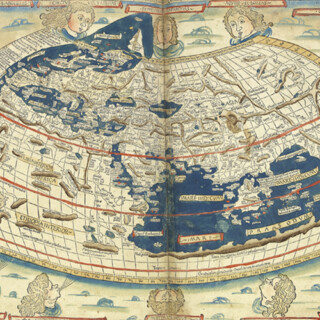
The majestic world map from the second printed atlas: 'Claudii Ptolemaei Alexandrini philosophi Geographiam Arnoldus Buckinck e Germania Romae', first published in Rome in 1478, and the first use of punched letters in a world map.
Ptolemy's map shows the world as it was understood by the Alexandrine ancients, on Ptolemy's first projection, i.e. modified cone shape, printed on two plates, extending from Great Britain in the northwest, the Canary Islands in the wes...
The majestic world map from the second printed atlas: 'Claudii Ptolemaei Alexandrini philosophi Geographiam Arnoldus Buckinck e Germania Romae', first published in Rome in 1478, and the first use of punched letters in a world map.
Ptolemy's map shows the world as it was understood by the Alexandrine ancients, on Ptolemy's first projection, i.e. modified cone shape, printed on two plates, extending from Great Britain in the northwest, the Canary Islands in the west, mid-China in the east, and northern Africa in the south, the Indian Ocean features a large island, Taprobana, now Sri Lanka, lettered in Roman capitals.
The world map in particular shows the refined level of detail which differentiates the Rome from the 1477 Bologna edition. The decorative wind heads and co-ordinate lines present in the Bologna edition are omitted, and place names are given more frequently: Shirley notes a dozen extra annotations in Arabia alone.
"The most influential cartographer of the ancient world was Claudius Ptolemy who lived in Alexandria in the second century [100-170 AD]. He was essentially a compiler, not an originator, and openly acknowledged the prior work of predecessors little known to us: principally Marinus of Tyre (who developed the idea of a network of meridians and parallels), Strabo and Hipparchus. The most important work of Ptolemy, his 'Geographia' consists of extensive tables of geographic coordinates of some 8000 localities… The world map stands apart from the regional ones as in the text it is clearly stated to have been originally drawn by one Agathodaimon of Alexandria. It is constructed on a simple conic projection and its earliest printed form [was published in 1477]". (Shirley).
While the Bologna edition of 1477 was the first atlas to use copperplate maps, the present series is generally regarded as superior for its clear captions, accurate projections and overall design. The Rome Ptolemy was certainly a greater commercial success than its predecessor and was reissued using the same copperplates, without change, in 1490, 1507, and 1508.
The early Italian Ptolemys, particularly the Rome editions, are "superb testimonials of Italian craftsmanship without the picturesque but unscientific monsters of the medieval maps or the addition of the adventitious decoration of later work, relying for their beauty solely on the delicacy of their execution and the fineness of the material employed" (Tooley).


![PTOLEMAEUS, Claudius [Untitled World Map].](https://i0.wp.com/crouchrarebooks.com/wp-content/uploads/2026/03/24625_2H.jpg?fit=4000%2C2882&ssl=1)