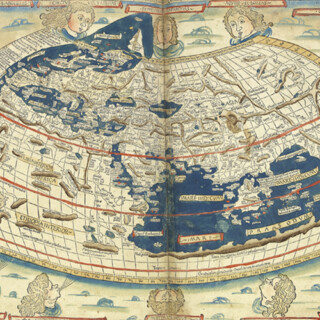
Floriano's intriguing and unusual double-hemisphere map is constructed on a polar projection, with each hemisphere cut into thirty-six gores, in the manner of printed globes. North and South America named 'America' and shown as one continent, separated from Asia; a large area of land and ice cover each pole; the border contains six fine strapwork cartouches, all but two are left mysteriously blank, and those contain portraits of Ptolemy and Floriano.
In 1555, the...
Floriano's intriguing and unusual double-hemisphere map is constructed on a polar projection, with each hemisphere cut into thirty-six gores, in the manner of printed globes. North and South America named 'America' and shown as one continent, separated from Asia; a large area of land and ice cover each pole; the border contains six fine strapwork cartouches, all but two are left mysteriously blank, and those contain portraits of Ptolemy and Floriano.
In 1555, the Venetian Senate granted Antonio Floriano, a painter and architect from Friuli, a privilege to publish this magnificent and unusual map of the world. In his application to the Doge of Venice himself, Floriano wrote that he had used his "diligence and knowledge" to create "a mappemonde which has never been made before, with the aid of which one can easily study and learn cosmography and see the entire picture of the world, since it can be reduced to spheric form...". Floriano's projection is a unique presentation of the world with the northern and southern hemispheres each divided into thirty-six segments of 10 degrees of longitude.
Floriano's map raises some very interesting questions. With its lack of either a title or imprint, one would assume that it was a proof copy, however all other known examples are similarly difficient. Floriano's decision to divide the two hemispheres into 36 globe gores might lead one to conclude that the map was intended to be dissected and mounted as a globe, since, as Shirley notes, in its undissected form the map "lack[s] legibility". However, the portraits of both Floriano and Ptolemy, together with the elaborate strap-work to the borders, make it unlikely that this was Floriano's intention. There is also some debate on the exact date of the map. It is known that Antonio Floriano was granted a privilege by the Venetian state to prepare and publish a world map in January 1555, with the present map published in the same year. However, several authorities have questioned this, stating the geographic information (copied from Mercator's 1538 cordiform map) leads to an earlier publication date between 1545-50. The engraving has been attributed to Paolo Cimerlino, due to the monogram that appears next to the portrait of Floriano, yet this seems unlikely.
bibliography:
bibliography:
Nordenskiold, Facsimile Atlas, p. 94 & fig. 48.; Tooley, Maps in Italian Atlases 23; Rudolfo Gallo, "Antonio Florian and his Mappemonde," Imago Mundi 6 (1949), 35-38; Shirley 99; Bifolco TAV. 37.


![FLORIANO, Antonio [Untitled Map of the World].](https://i0.wp.com/crouchrarebooks.com/wp-content/uploads/2025/12/24612_1H.jpg?fit=4000%2C2412&ssl=1)